Get fast on the keyboard
Talk to Your Agents
The keyboard was the interface because a human had to type code. Now the interface is a conversation, and you should be having it out loud.
I taught typing. Not officially, but every beginner cohort got the same speech: learn your editor, learn the shortcuts, get your hands off the mouse. The keyboard was the instrument, and getting fast on it was the whole game.
For over a year now I've mostly talked to my computer instead, and it's weird. I'm going to admit that up front so you don't bail on the idea the first time you feel ridiculous. You will feel ridiculous. Then you'll look at the numbers.
Where the words come from now
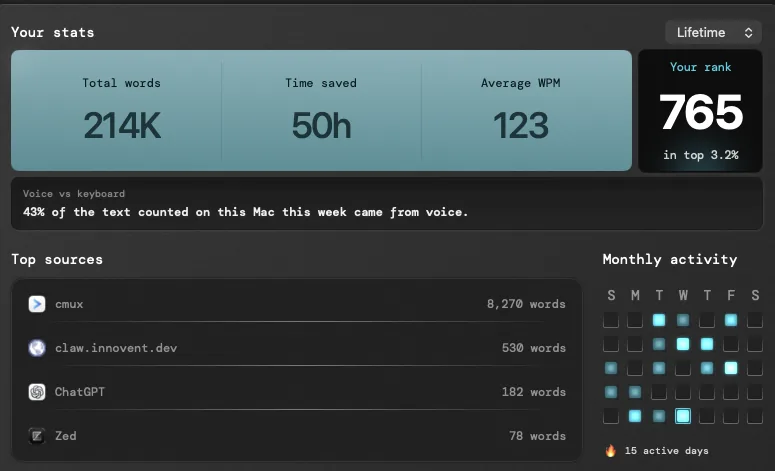
43% of everything I typed on this Mac this week came out of my mouth, not my fingers. And the top sources aren't email or Slack. They're my terminal and my agents. That's not an accident. It's the whole point.
The keyboard was for the compiler
Every reason we optimized for typing was because the thing we produced had to be exact. A missing semicolon broke the build. Code was for machines first and humans second, so the interface had to be precise, and precision meant a keyboard.
I'm not producing code anymore. I'm producing intent. Plans, specs, "no, not like that, more like the thing we did in the admin," and "run the suite, then check the screenshots." That output is not exact. It's a conversation. And I talk about three times faster than I type, with far less friction in the part that matters: getting the whole thought out before I've edited it down to something smaller.
Here's the same request, both ways.
Typed. "Add series support. Post belongs to series with part number. Prev/next links. Admin reorder." Then I go back and add the parts I skipped because typing them was tedious.
Spoken. "Add series support to the blog. A post can belong to one series and has a part number. On the post page show prev and next links and a label like Part 3 of 9. The series page lists everything in order but hides drafts from anyone who isn't logged in. Admin should be able to reorder parts without editing each post. Write system specs from that, one for reading through part one into part two and one proving a logged out visitor never sees a draft. Then screenshot the series page in light and dark."
The second one took me about 40 seconds. It's also the version that gets a one-shot result, because the agent had the whole plan instead of the compressed one. When I type, I economize. When I talk, I explain. Agents do better with explaining.
What changed in my day
| Typing to agents | Talking to agents | |
|---|---|---|
| Length of a prompt | Short, because typing is work | Long, because talking is free |
| What I leave out | Constraints, verification steps, examples | Almost nothing |
| Corrections | Retype, or accept something close enough | "No, I meant..." and keep going |
| Running several agents | One at a time, hands busy | Bounce between three, hands free |
| What it feels like | Writing a ticket | Pairing with someone who never gets tired |
The last row is the real shift. When I dictate, I stop treating the agent like a form and start treating it like a colleague. I narrate what I'm seeing. I think out loud about tradeoffs. Half my best plans this year came from rambling at an agent for two minutes and asking it to turn that into a spec.
It's also how I catch my own bad ideas. Saying "and then we'll just duplicate the auth check in both services" out loud is a lot more embarrassing than typing it, and sometimes that's enough to stop me.
The awkward part
Nobody tells you this: the first week is bad. You feel self-conscious. You say "um" and it shows up in the prompt. You're used to editing while you type, and now the words just land. Your office mate looks at you.
Push through. Somewhere in the second week the editing moves from your fingers to your mouth. You start speaking in complete thoughts because you've noticed that's what works. The apps clean up the ums. And you find out your brain has a lot more to say than your hands were ever willing to type.
Every, the writing collective behind Monologue, has written the best guide I've read on this. Their framing is that voice removes a translation step: you used to have to turn a messy thought into a clean instruction before work could start, and now you don't. That matches my experience exactly.
The apps
I use Monologue. It's from Every, it's screen aware, so it knows I'm in a terminal and formats accordingly, and it's the one that produced the stats above. It's $15 a month on its own, or you get it as part of the Every subscription at $30 a month with their other apps and the newsletter. I'd pay for the subscription anyway. The writing is worth it, and the app is a bonus.
Here are the other ones worth trying, two paid and three free.
Wispr Flow (paid, $12 to $15 a month, free tier). The most polished of the bunch and it runs on Mac, Windows, and phones. Great cleanup, a personal dictionary that learns your jargon. Cloud processing, so if you're dictating anything sensitive, know that.
Superwhisper (paid, about $8.49 a month, with a lifetime option). Runs fully offline on Apple Silicon and has "modes" that reshape your speech for different targets, like a casual message versus a spec. More knobs than Monologue, which is either a pro or a con depending on who you are.
Handy (free, open source). One hotkey, speak, text lands in whatever field you're in. Everything runs locally. No cleanup and no AI polish, so your ums come through. If you want to see whether voice is for you before paying anyone, start here.
VoiceInk (free if you build it, $25 one time if you don't). Open source, local models on the Neural Engine, and it does the AI cleanup that Handy skips. Mac only, Apple Silicon only. The best value on this list.
Apple Dictation (free, already on your Mac). Press the microphone key. It's fine for a sentence and falls apart on a paragraph, and it has no idea what a "Stimulus controller" is. Try it for a day so you appreciate the others.
Kill the typing nostalgia too
I told students that the keyboard was where the craft lived. The muscle memory, the flow state, the feeling of a thought going straight from your head into a file. That feeling was real. It was also a feeling about producing code.
I don't produce code. I produce direction, and direction is a thing people have been giving each other out loud for a lot longer than we've had keyboards. It's the most natural interface there is. It just took an agent on the other end to make it useful.
This is part of Rethink Everything. If you're only going to try one thing from this whole series, try this one.